5 Best Drone Battery Charger In 2026
As an Amazon Associate we earn from qualifying purchases.
Flying a drone is a lot of fun, but the battery is the part that needs the most care. Picking the best drone battery charger can make charging faster, safer and easier to manage. This guide is written for beginners who want to understand their options before they spend money.
The five products below share a common purpose: they charge the lithium batteries that power many drones and small radio-controlled (RC) vehicles. Some are small single-port boards for tiny drones, while others are larger chargers with two channels and a big screen. This comparison rests on the listed features and typical use, not on personal testing.




1. ISDT E625 6-Channel 1S LiHV/LiPo Battery IPS: best for tiny whoop drones
This is a compact smart charger and discharger built for single-cell (1S) batteries. It suits people who fly small “tiny whoop” style FPV drones and want to charge several packs at once. Because it has six separate ports, it can handle a small fleet of batteries from one place.
What it does well
The charger offers six independent channels, each able to deliver up to 2.5A. That means each battery gets its own charging path, which keeps things organized. It also includes storage charging, which brings batteries to a safer resting voltage when you are not flying them for a while.
Key features in simple words
The 1.9-inch color screen shows battery status and each cell’s voltage. A built-in overheat protection and alert function helps stop problems before they grow. Input options include USB-C with power delivery and an XT60 connector, so you can power it from a portable adapter.
Everyday use
In practice, most people use a board like this at a workbench or at a field spot with a portable power source. Because it weighs only about 95 grams and fits in one hand, it is easy to slip into a bag. Plugging in packs and reading the screen is simple, even for a first-timer.
Performance and ease of use
The total output is limited to 8W across all six ports, so it is best for small batteries rather than large ones. Charging a single pack is quick and straightforward. Setup is mostly a matter of picking the right battery type on the screen.
Value for money
At its listed price, this charger sits at the lower end of the range in this round-up. For small 1S packs, that is a sensible spend. Larger batteries will call for a different tool.
Pros
- Six independent channels for charging several small packs at once
- Clear color screen with per-cell voltage readings
- Compact and lightweight for travel
- Built-in storage charging and overheat protection
Cons
- Total output of 8W limits charging speed for larger batteries
- Designed mainly for 1S packs, so it does not suit bigger setups
- Requires a separate power adapter for full use
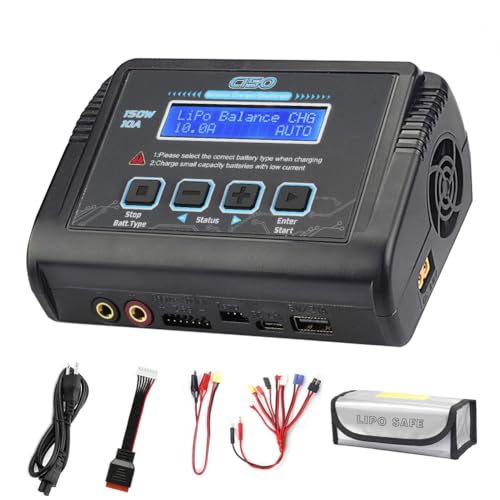
2. LiPo Battery Charger Dual 10A RC Fast: best for flexible multi-chemistry charging
This dual-channel charger is aimed at hobbyists who work with many battery types. It handles lithium, nickel and lead-acid packs, which makes it useful for RC cars, boats and aircraft as well as drones. It suits someone who wants one machine to cover most of their batteries.
Two channels, many battery types
Two channels let you charge two different batteries at the same time, as long as each uses its own channel. The unit supports a wide range of lithium cell counts from 1S to 6S, along with nickel and lead-acid chemistries. Because of this range, it can grow with your hobby.
Useful modes and memory
Charge, balance charge, discharge and storage modes cover the basics. The charger can save 20 memory profiles, so you can rec lall the settings for your favorite batteries and recall them with a few presses. This saves time and reduces mistakes when you switch between packs.
Ease of use
The large screen makes it clear which mode and voltage you have selected. Because the unit can detect the cell count automatically in charging or discharging status, you do not always need to set it by hand. Even so, you should always confirm the battery type before you start.
Power and value
The listed maximum output is 150W on AC input and 240W on DC input, with charge current up to 10A per channel. Power like this suits larger packs that need more time on a slower charger. At its listed price, this model sits in the middle of the range for a dual-channel unit.
Pros
- Two channels allow simultaneous charging of two batteries
- Supports lithium, nickel and lead-acid battery types
- Stores 20 memory profiles for quick recall
- Large screen with automatic cell count detection
Cons
- Many options can feel overwhelming to a complete beginner
- Each channel must have its own battery, which requires care
- Requires a suitable power source to reach its full output
3. LiPo Battery Charger: best for detailed battery monitoring
This single-channel charger focuses on monitoring and control. It offers a battery meter, internal resistance checking and an adjustable end voltage. It suits users who like to look closely at what their batteries are doing.
Built-in meter and checks
The battery meter displays cell count, total voltage, capacity percentage and each cell’s voltage. An internal resistance check can help you spot a pack that is starting to wear out. Together, these tools give a clearer picture of battery health.
Adjustable end voltage
The end voltage for charging can be set between 3.85V and 4.3V per cell. The maker notes that this feature is for expert users only. For beginners, leaving the standard settings in place is the safer choice.
Power and cooling
The listed maximum output is 150W, with charge current up to 10A. A built-in cooling fan helps manage heat during longer sessions. The shell is described as fire-proof, which adds a sense of security.
Ease of use
There are many menus and functions to learn. The charger does offer automatic cell count identification and memory storage, which simplifies routine charging. Taking time to read the manual pays off here.
Value for money
Given its monitoring tools and high power output, this charger offers a good set of features for its listed price. It is a practical choice for someone who wants insight into each pack.
Pros
- Battery meter shows per-cell voltage and capacity percentage
- Internal resistance check helps assess pack condition
- Built-in cooling fan and fire-proof shell
- Stores 20 memory profiles and auto-detects cell count
Cons
- Advanced settings are not suited to complete beginners
- Menus take time to learn
- Single channel means one battery at a time
4. 2pcs Drone Battery JST Connector: best for simple, budget-friendly charging
This is not a full charger in the usual sense. It is a pair of USB-to-JST charging cables made for certain Sky Viper drone batteries. It suits a beginner with a compatible drone who wants a basic, low-cost way to charge.
How it works
You connect the cable to a USB source such as a computer or a power bank. The red light changes to show charging status, although the exact behavior depends on the charging board. The cable stops charging automatically when the battery is full.
Everyday use
Because it is plug-and-play, you can charge without watching it closely. Many people find it convenient to start a charge and move on to other tasks. The cable is small en ough to fit in a pocket, which helps when you travel with your drone.
Performance and limits
This cable charges at the rate that the USB source allows, and it does not offer the detailed controls of a full charger. It does not show per-cell voltages or support storage modes. Because of this, it is best seen as a simple option rather than a complete charging system.
Compatibility check
The product is made for specific Sky Viper models, so the connector must match your battery. Before buying, confirm that your battery uses this JST plug. Using the wrong connector can waste money or cause problems.
Value for money
At its listed price, this two-pack is one of the most affordable items in this round-up. For a compatible drone, it can be a sensible way to get extra charging capacity. Still, it is a narrow tool with a narrow purpose.
Pros
- Very low cost compared with full chargers
- Plug-and-play use with no complicated setup
- Stops charging automatically when the battery is full
- Compact enough to carry easily
Cons
- Works only with compatible Sky Viper batteries
- No detailed monitoring or storage modes
- Charging speed depends on the USB power source
5. LiPo Battery Charger Dual 10A Fast Balance: best for larger workshops
This dual-channel charger is similar in design to the second product in this round-up. It suits hobbyists with several RC vehicles who want to charge two packs at the same time. It is a good fit for a shared workbench or a club setting.
Dual channels and wide support
The two channels allow simultaneous charging, provided each battery has its own channel. Support covers lithium, nickel and lead-acid families, plus smart batteries. This breadth makes it flexible across many hobby projects.
Large screen and memory
The large screen helps you choose modes and adjust voltage and current. The memory function stores 20 profiles, so you can recall your settings for each battery type. Together, these features keep routine charging organized.
Power and performance
The listed maximum is 150W on AC input and 240W on DC input, with up to 10A charge current per channel. Discharge power is listed at 10W. These figures suggest the unit can handle sizeable packs, though charging time always depends on battery size and settings.
Value for money
At its listed price, this charger sits close to the other dual-channel model in this round-up. Picking between them often comes down to brand preference and the specific features you value most. Reading both feature lists side by side can help you decide.
Pros
- Two channels allow simultaneous charging
- Wide battery compatibility across several chemistries
- Large screen and 20 memory profiles
- Automatic cell count detection in charging and discharging
Cons
- Full output requires a suitable power supply
- Many settings can take time to learn
- Channels must be used with separate batteries
Comparison insights: how these chargers differ
The five products fall into two broad groups. Three are full chargers with screens and modes, while one is a basic USB cable and one is a multi-port board for small packs. Each group serves a different kind of buyer.
On performance, the dual-channel units offer the highest listed power, with up to 150W on AC input. The six-port board is limited to 8W total, which keeps it suited to small batteries. The USB cable depends entirely on the power source you connect it to.
Ease of use varies too. The large-screen dual chargers come with many options, which can feel busy at first. The six-port board is simpler to read, and the USB cable is the easiest of all to start using.
For value, the lowest-priced item is the USB cable, while the dual-channel units sit at the higher end of the listed prices. Because of this, the right choice depends on what you fly and how many batteries you char ge at once.
A low-cost option can be sensible for one compatible drone, while a dual-channel unit makes more sense for a larger collection.
Buying guide: key factors explained in plain words
Before you buy, it helps to know what the main specifications mean. A charger is only useful if it matches your batteries.
Start with the battery type and cell count, which are usually printed on the pack.
Battery chemistry and cell count
Lithium packs such as LiPo are the most common in drones. Each cell in these packs has a nominal voltage, and the cell count is the number of cells joined together.
A “1S” pack has one cell, while a “6S” pack has six. Your charger must support the chemistry and cell count of your battery.
Channels and charging speed
A channel is one charging path. Single-channel chargers handle one battery at a time, while dual-channel units can handle two. More channels can save time when you have several packs to recharge.
Power output
Power, measured in watts, tells you how quickly a charger can deliver energy. Higher wattage can shorten charging time for larger batteries. Keep in mind that your power source must also be able to supply that output.
Monitoring and screen
A clear screen helps you read voltages, modes and progress. Some chargers show per-cell readings, which can help you spot an imbalance. Beginners often find a readable display reassuring.
Safety features
Look for protections such as overheat alerts, automatic stop at full charge and current limits. Storage charging, which leaves batteries at a moderate voltage, can help protect them between flights. Always charge in a ventilated space away from flammable materials.
Portability and power source
Some chargers run from a wall outlet, while others use a car battery or a portable adapter. Think about where you will charge most often. A lightweight unit is handy if you fly in the field.
Who should buy these products
Each product suits a different kind of buyer. Matching your needs to the right type of charger is the simplest way to avoid wasted money. The list below is a general guide, not a strict rule.
- Owners of small tiny whoop drones: The six-port ISDT board suits people with several small 1S packs who want to charge them together.
- Hobbyists with mixed battery types: The first dual-channel LiPo charger suits people who fly drones, cars and boats and want one unit for many chemistries.
- Users who want detailed monitoring: The single-channel LiPo charger with a battery meter suits someone who wants to look closely at pack health.
- Beginners with one compatible drone: The JST cable pair suits someone with a supported Sky Viper drone who wants a simple, low-cost way to charge.
- Shared workshops and clubs: The second dual-channel model suits a shared bench where two packs charge at once.
If you are unsure, start by listing your batteries and their cell counts. Then compare that list against each product’s listed support. This simple step prevents most buying mistakes.
Final verdict
No single charger is the best choice for everyone. The right pick depends on your battery types, how many packs you charge, and how much control you want. Each product in this round-up has a clear niche.
For small tiny whoop drones, the six-port board is a neat and portable choice. For mixed hobbies and larger packs, the dual-channel units offer more power and flexibility. For a simple, low-cost start with a compatible drone, the USB cable pair is a sensible option.
In short, match the charger to your batteries first, and let the features follow. Reading the full specifications before you buy will help you choose with confidence.
Frequently Asked Questions
What is the best drone battery charger for beginners?
There is no single answer, because it depends on your drone. Beginners with a small 1S drone often find a compact multi-port board easy to use. Those with a supported drone may prefer a simple cable.
Can I charge two batteries at the same time?
Yes, but only with a dual-channel charger like two different batteries on separate channels. Each battery needs its own channel, so the two packs should never share one. Check the manual before you connect both packs.
What does storage charging mean?
Storage charging brings a lithium battery to a moderate resting voltage. This helps protect the cells when a pack will sit unused for a while. Many chargers offer this as a built-in mode.
Do I need a power adapter for these chargers?
It depends on the model. Some chargers need a separate power adapter, while others plug into a standard outlet. The USB cable needs a USB source such as a computer or power bank.
Is it safe to leave a battery charging unattended?
Most modern chargers stop automatically at full charge, but it is still wise to stay nearby. Always charge in a ventilated space, away from flammable materials, on a heat-resistant surface. Never ignore a swollen or hot battery.

Peterson is an RC hobby enthusiast and product reviewer with a passion for remote-controlled cars, trucks, boats, drones, and accessories. He enjoys testing the latest RC products, comparing features, and sharing practical buying guides to help beginners and experienced hobbyists make informed decisions. Through RCThing.com, Peterson provides honest reviews, maintenance tips, and expert advice to help readers get the most from their RC adventures.