5 Best RC Crawler Servo In 2026
As an Amazon Associate we earn from qualifying purchases.
Picking a servo can feel confusing when you first build or upgrade an RC crawler. The servo is the small motor that turns the wheels left and right, so it shapes how well your truck steers over rocks and trails. This guide helps beginners understand what a good servo looks like and how five popular options compare.
The five products below share a common purpose. Each one is a digital steering servo sized for 1/8 or 1/10 scale crawlers, trucks and similar models. Several also offer waterproof sealing, metal gears and a 25T servo horn, which is the arm that connects the servo to the steering linkage. This comparison rests on the listed features and typical use, not on personal testing.
Before you compare specifications, check three basics: the voltage your receiver and battery can supply, the physical size that fits your chassis, and the steering load your tires create. A servo that is too weak will struggle on sticky terrain, while one that is much stronger than you need may add weight and cost without a clear benefit.



1. FLASH HOBBY 45KG Coreless Servo 8.4V High: best for strong steering on larger crawlers
What this servo is and who it suits
This is a coreless servo rated at 45kg torque at 8.4V. Torque is the turning force a servo can deliver, and higher numbers help when a large tire must turn against resistance. It suits builders who run bigger tires or heavier bodies on 1/10 and 1/12 trucks.
If your truck uses small tires on a light body, you may never need this much force. Matching the servo to the load you actually expect is a practical way to avoid overspending.
Key features in plain words
The housing is made of CNC aluminum, a machined metal that helps move heat away from the motor. The gears are steel, which resist wear better than plastic. A coreless motor is lighter and responds quickly because it has no iron core to slow it down.
Metal gears are generally more durable under shock loads, such as when a tire hits a rock. Plastic gears can be cheaper to replace, though, so some builders keep spare parts on hand either way.
Waterproofing and real-world use
The servo carries an IP67 rating, which means it is sealed against dust and can survive short submersion in water. Buyers who drive through puddles or streams often value this. Still, a rating is not a promise of protection from every condition, so rinsing and drying the electronics after wet runs remains sensible.
Sealed servos still benefit from checking the cable connector and the servo horn screws after each wet session. Mud and grit can work into small gaps over time, even when the seal itself holds.
Performance and ease of use
The listed speed is 0.12 seconds for 135 degrees at 6V and 0.11 seconds at 8.4V. Its 270-degree control angle covers a wide steering range. Installation is simple because a horn and accessories come in the box.
Speed matters most when you make quick corrections on a trail. Wide steering angle matters when you need tight turns in confined spaces. Check that your transmitter and electronic speed controller can handle the voltage you plan to use before you wire everything together.
Value for money
At the listed price, this servo sits in the middle of the group. Its high torque and metal build give it a strong feature set for the cost. Buyers on a tight budget may find the same torque is not needed for a smaller truck.
A useful way to judge value is to ask if each feature will change how you drive. If you rarely face heavy steering loads, paying for extra torque may not improve your results.
Pros
- High listed torque for heavier or larger-tire builds
- Aluminum housing and steel gears for durability
- IP67 sealing for wet and dusty terrain
- Wide 270-degree steering range
Cons
- Higher torque than a small crawler may need
- Waterproof rating does not remove the need for after-run care
- Seller reputation is described only as moderate, so check recent buyer feedback
2. GOTECK 55KG Coreless Digital Servo: best for maximum torque and rugged conditions
Overview for heavy-duty builds
This servo lists a maximum torque of 58kg/cm at 8.4V, the highest figure in this group. It is aimed at heavy trucks, monster trucks and rugged crawlers. It also works with 1/6 and 1/8 scale models.
Heavy torque matters most when a vehicle carries a large body, big tires or a steering linkage under load. In those cases, a stronger servo can hold its position more reliably. Builders of lighter vehicles should still compare the figure against their own setup before buying.
Construction and steering details
The gears are reinforced steel with pins, and the unit uses three ball bearings. Ball bearings help the output shaft turn with less friction and can support side loads better than bushings alone. A full aluminum housing helps move heat away during work.
The listed speed is 0.08 seconds for 60 degrees at 8.4V, which is among the quickest in the group. Faster speed can make steering feel more immediate on rough ground, where the wheels need to correct quickly. Listed specifications like these come from the manufacturer, so they are best read as a starting point rather than a guarantee.
Water and dust protection
The IP67 design is listed as able to work after immersion up to one meter for 30 minutes. This gives a clear sense of how well the seal is meant to hold, though no real-world test results are provided here. Buyers who cross deep puddles or muddy streams usually value a specific depth rating like this one.
Seals can still wear over time, especially around the output shaft and cable entry point. Checking the seals and cable grommets after muddy outings is a simple habit that helps keep the unit protected. Water resistance also depends on how well the servo is installed and how the wiring is routed.
Value for money
The price sits close to the first product in the group, which makes the high listed torque stand out. For builders who need strong steering in demanding conditions, the feature set is attractive. Those running lighter models may not need this much force, so the extra capability could go unused.
Pros
- Highest listed torque in this group at 8.4V
- Reinforced steel gears and three ball bearings
- Aluminum housing to help with heat
- Specific waterproof depth rating listed
Cons
- Strong torque may be excessive for small or light crawlers
- Listed as a 270-degree unit, so check fit with your steering setup
- Seller reputation is described only as moderate, so review recent feedback
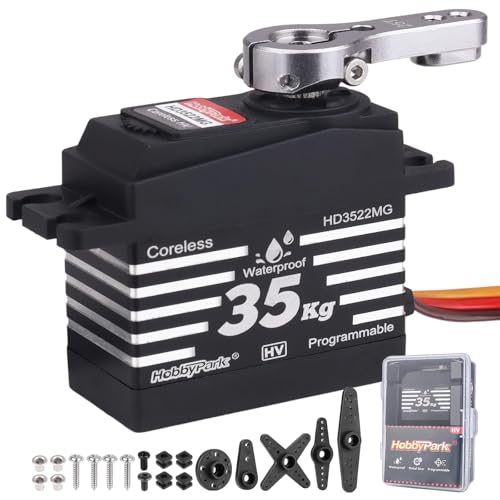
3. HobbyPark Waterproof 35KG High Torque Servo: best for all-weather DIY projects
Who this servo is designed for
This servo offers 35kg of torque and works with 1/8, 1/10 and 1/12 crawlers, trucks, cars, boats, airplanes and robots. Its broad compatibility makes it a flexible option for hobbyists who work on several projects. It is also a good fit for builders who enjoy the setup process.
A servo that works across several vehicle types can save money if you build more than one model. Check the voltage and mounting size against each project, since a servo that fits one chassis may not fit another without adapters.
Programmable rotation and build quality
The listed 180-degree rotation can be programmed, which means the steering range can be adjusted through the controller. This is useful when a build needs a specific steering angle rather than the full travel of the servo. Programming is done through the controller’s settings, so the exact steps depend on your transmitter or board.
The coreless motor and stainless steel gears are described as smooth and durable. A coreless motor has a lighter rotor, which can help with quick response. A 25T horn is included for easy mounting, and horn choice affects how far the linkage can swing.
Power input and everyday handling
The servo supports up to 8.4V input, which can give faster response when the power system allows it. Always confirm that your battery and receiver can handle the voltage before connecting. Using a voltage above what the rest of the system supports can cause damage.
Wet, muddy or rough terrain is listed as a key use case because of the IP67 protection. Installation is described as straightforward, which helps newer builders. Even so, keeping the wiring secure and the connectors dry will protect the unit over the long run.
Value for money
This is the least expensive option among the five at the listed price. Its torque sits between the lighter and heavier units, which suits many mid-sized crawlers. The package offers solid features for the cost, though buyers should match the 180-degree range to their steering needs.
For a budget-minded builder who wants water resistance and programmable travel, this option covers many common needs. Buyers who need the widest steering angle or the highest torque may want to compare the other models in this group.
Pros
- Lowest listed price in the group
- Wide compatibility across RC vehicles, boats and robots
- Programmable rotation for flexible setup
- Stainless steel gears and IP67 sealing
Cons
- The 180-degree range is narrower than some alternatives
- Programming options take extra time to learn
- Seller reputation is described only as moderate, so check buyer feedback
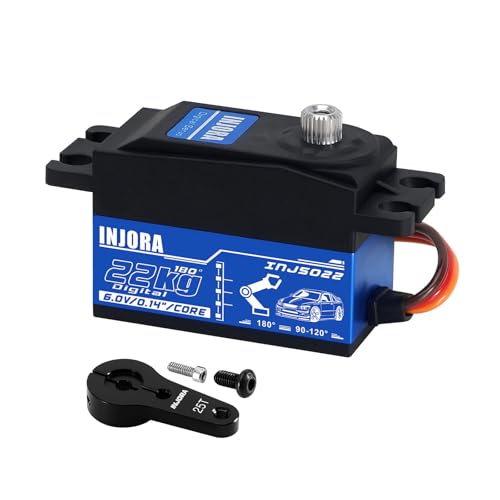
4. INJORA INJS022 22KG Low Profile Digital Servo: best for compact 1/10 crawlers
Who this servo suits
This is a low profile servo, which means it has a flat, compact body that fits tight spaces. It is aimed at 1/10 RC crawlers and robots where room is limited. Builders working with narrow chassis layouts or tight steering linkages will find the slim profile easier to mount. Its light weight can help keep the front end balanced, which matters on slow, technical terrain where small shifts in weight affect grip.
Construction and key features
Full metal gears and dual ball bearings support smooth movement under load. The plastic case has an aluminum center band, and the total weight is listed as 50g. Metal gears generally handle shock and stress better than plastic ones, which is useful when a crawler bounces over rocks or logs.
A 25T aluminum horn is included, with a remote control angle of 90 to 120 degrees. Check that the horn’s spline count and arm length suit your steering setup before you install it.
Speed and torque in daily use
The listed speed is 0.14 seconds at 6.0V, with 22kg of torque. At 4.8V the figures change to 0.17 seconds and 17.6kg. Lower voltage means less force, so builders should match the servo to their power setup. In practice, a battery pack that sags under load can reduce steering strength even when the servo itself is rated well. Testing steering under real driving conditions helps confirm that the servo keeps up with your build.
Value for money
At the listed price, the servo is one of the lowest-cost options in this group. For a compact 1/10 build, the feature set fits a practical budget well. Buyers who need strong steering on larger tires will likely want more torque than this unit offers. Comparing the listed torque with your tire size and vehicle weight is a simple way to decide if this servo meets your needs.
Pros
- Low profile body suits tight chassis layouts
- Light weight of 50g
- Full metal gears and dual ball bearings
- Among the lower prices in this group
Cons
- Torque is lower than the heavier servos here
- Lower voltage reduces both speed and force
- Not suitable for children under 14, as the listing states
5. HOOYIJ 2 Pack High Torque 40KG Digital Servo: best for multi-model builders
What this two-pack includes
This package contains two DS3240MG servos, so it can equip two models or serve as a spare set. Each unit lists 40kg of torque and a 180-degree control angle. It is widely described for planes, helicopters, boats and crawlers. Having a spare on hand can save time if one unit fails during a race day or a long outing, since replacing a servo mid-session is far easier when you already own a matching unit.
Precision and signal details
The servo uses a digital chip and stainless steel gears with potentiometers, which help with accuracy and linearity. The pulse range is 500 to 2500 microseconds, which is the signal length that tells the servo where to turn. Your controller must reach 2500 microseconds for the full 180-degree range, so this detail matters before purchase.
If your receiver or transmitter only supports a narrower range, you can still use the servo, but you may not reach its full travel. Confirm your system’s endpoint settings first.
Waterproofing and everyday handling
Waterproof rubber seals are listed on the screws, and the housing is CNC aluminum. Low noise and smooth motion are noted in the features. The dead band of 3 microseconds is a small gap that affects how precisely the servo responds to tiny signal changes.
Smaller dead bands generally mean finer control, so this figure is worth considering if you run precise maneuvers. Waterproof seals help with splashes and wet conditions, but they do not make the servo fully submersible, so rinse and dry it after use near water.
Value for money
Buying two servos at the listed price gives a clear per-unit advantage for builders who need a pair. The 40kg rating places it between the mid and high torque options. Buyers who only need one servo may find the pack more than they require.
If you plan to use one unit now and keep the other as a spare, the pack can be a sensible choice even when a single model would cover your current build.
Pros
- Two servos included in one package
- Stainless steel gears with precise potentiometers
- Waterproof rubber seals on the screws
- Wide use across cars, planes and boats
Cons
- Requires a controller that can send 2500 microsecond pulses
- Pack may be more than a single-model builder needs
- Seller reputation is described only as moderate, so check recent feedback
Comparison insights: how these servos differ
The five servos fall into three rough groups. The first two, the FLASH HOBBY and GOTECK units, carry the highest listed torque and suit heavier builds. The HobbyPark and HOOYIJ units sit in a middle range, while the INJORA is the lightest and most compact.
Performance follows torque and speed. The GOTECK lists the quickest 60-degree speed at 0.08 seconds, though all five servos are fast enough for typical crawling. Because of this, torque usually matters more than small speed differences for most trail driving. A slightly slower servo with enough force will hold a steering angle better than a fast one that struggles under load.
Ease of use varies by setup. The HobbyPark offers programmable rotation, which adds flexibility but also a learning curve. Adjusting the rotation range usually means working through the settings once before the first run. The INJORA and HOOYIJ are simpler to fit once the controller signal is confirmed. On the other hand, the HOOYIJ needs a controller that reaches 2500 microseconds, so check your transmitter or receiver before you install it.
Value for money depends on the build. The HobbyPark has the lowest listed price, while the HOOYIJ two-pack offers the most units. A two-pack helps if you run front and rear steering or plan to build a second truck. The INJORA suits a tight budget on a 1/10 chassis. Still, a cheaper servo only saves money if its torque matches your truck. An underpowered unit can lead to replacement costs that erase the initial savings.
Buying guide: key factors explained in plain words
Torque is the first number to check. It tells you how much turning force the servo can produce. Match it to your tire size, weight and terrain rather than picking the highest number. A heavy truck with large, deep-tread tires needs more force than a light scale rig on smooth ground.
Scale matters because each servo is sized for certain models. Most listings name the scales they fit, such as 1/8, 1/10 or 1/12. Check the listed scale before you buy so the servo fits the chassis and mounting points. Measure the mounting holes on your current servo if you are replacing one, since small differences can prevent a clean fit.
Speed describes how quickly the servo moves from one position to another. Faster is better for quick steering changes, but most crawling is slow and controlled. For that reason, speed is usually a secondary factor. Speed becomes more useful on fast, responsive vehicles where quick corrections matter.
Waterproofing is worth a closer look if you drive in wet or muddy places. An IP67 rating means the unit is sealed against dust and short submersion. Even so, rinse and dry the electronics after wet runs to help the seals last. Water and grit can still find their way in over time, so regular cleaning remains a good habit.
Voltage affects output. Some servos list performance at 6V and 8.4V, and the figures change with power. Higher voltage generally increases speed and torque, but only if the servo is rated for it. Confirm that your battery and electronic speed controller support the voltage you plan to use, and check the manufacturer’s specifications before raising the voltage.
Control angle is the total steering range the servo can cover. A 270-degree unit gives more travel than a 180-degree unit, though the right choice depends on your steering linkage. Check how the horn and linkage fit before you order. A servo with more travel than your linkage can use gives no benefit and may cause binding.
Metal gears and bearings add durability. Steel and aluminum parts resist wear better than plastic, while ball bearings help the servo turn smoothly. Expect the metal build to add some weight and cost. For a light scale truck that rarely sees hard impacts, plastic gears may be enough.
Finally, read the package contents. Some listings include a horn and accessories, while others sell a pair. Knowing what comes in the box helps you compare the true cost of each option. A low price can look less attractive once you add a horn, screws or a second unit you need to buy separately.
Who should buy these products: matching buyers to each servo
Builders with large tires or heavy bodies may want the FLASH HOBBY 45KG unit. Its high listed torque and metal construction suit demanding steering loads. It is a strong pick for larger 1/10 and 1/12 trucks.
For rugged, deep-water trail use, the GOTECK 55KG is the most powerful option here. Its listed torque and specific waterproof depth rating suit drivers who push their trucks hard. It is best for heavy-duty builds rather than light crawlers. If your trail runs include frequent creek crossings, this rating matters more than it does on dry dirt tracks.
Hobbyists who work on several kinds of projects may prefer the HobbyPark unit. Its wide compatibility, programmable rotation and low listed price make it a flexible choice. It suits builders who enjoy adjusting setups. Someone who swaps between a crawler, a buggy and a drift car may find this versatility useful over time.
Owners of compact 1/10 crawlers with limited space should consider the INJORA INJS022. Its low profile body and light weight fit tight chassis layouts. Its listed age recommendation is 14 and up, so it is not for young children. Compact chassis often leave little room for bulky parts, so checking the dimensions against your mounting area is a smart first step.
Builders who need spares or want to equip two models may find the HOOYIJ two-pack useful. It offers two servos with stainless steel gears and waterproof seals. Keeping a spare on hand can save a trip when a servo fails mid-session. Just confirm that your controller can reach the 2500-microsecond pulse range first.
Final verdict: which servo fits your build
No single servo suits every crawler. The right choice depends on your scale, tire size, terrain and budget. Start with torque and voltage, then check fit and waterproofing. Doing these checks in order helps you avoid buying a servo that looks good on paper but does not fit your truck.
For most beginners on a mid-sized 1/10 crawler, the HobbyPark and HOOYIJ units offer a sensible balance of torque, features and price. Heavier builds point toward the FLASH HOBBY or GOTECK. Compact builds with a tight budget suit the INJORA.
Whatever you choose, confirm the listed specifications against your setup and read recent buyer feedback. Because all five sellers are described as moderate, checking current reviews is a practical step. Look for comments about real-world steering speed, heat under load and how well the gears hold up after repeated use.
Frequently Asked Questions
What does servo torque mean?
Torque is the turning force a servo can apply. Higher torque helps move heavier tires or steering loads. Match it to your truck rather than picking the largest number. A servo with more torque than you need often costs more and can draw more power from your battery.
Do I need a waterproof servo?
A waterproof servo helps if you drive through puddles, streams or mud. Dry electronics after wet runs to protect the unit. Dry dirt-only trails may not need this feature. Even a water-resistant servo benefits from a quick wipe and dry-out after muddy sessions.
Which scale should my servo match?
Most of these servos are listed for 1/8, 1/10 or 1/12 scale models. Check the listing and your chassis before buying. The servo must also fit your mounting points. Measure the mounting tabs and the output shaft position on your current servo, then compare them with the new listing.
What is a 25T servo horn?
A 25T horn is the arm with 25 spline teeth that connects the servo to the steering linkage. Many of these servos include one. Make sure the spline count matches your linkage parts. A mismatched horn may not fit the output shaft at all, or it may sit at the wrong angle and limit steering.
Is a higher voltage always better?
Higher voltage can increase speed and torque, but only if your battery, receiver and electronic speed controller support that voltage. Check the specifications of every component before you raise the power level. Mismatched voltage can damage electronics, so the safest choice is the voltage your system is designed for.
Do I need a special controller?
Some servos, such as the HOOYIJ pack, need a controller that can send signals up to 2500 microseconds for the full steering range. Check your transmitter and receiver settings before you install a new servo. A quick test with the wheels off the ground helps confirm the range is correct. Adjust endpoints in small steps so the steering never pushes against its mechanical stops.

Peterson is an RC hobby enthusiast and product reviewer with a passion for remote-controlled cars, trucks, boats, drones, and accessories. He enjoys testing the latest RC products, comparing features, and sharing practical buying guides to help beginners and experienced hobbyists make informed decisions. Through RCThing.com, Peterson provides honest reviews, maintenance tips, and expert advice to help readers get the most from their RC adventures.